Showing posts with label GMail. Show all posts

Friday, 24 May 2013

My Android Conundrum: Benefits of Androids


This is a quick post on the benefits of Android, at least for me! Android is a mobile OS I have only used for a few weeks, and only on low-end devices like the HTC Wildfire S and the Samsung Galaxy Ace. During my brief usage of the platform I continually found my experience let down and hamstrung by shoddy hardware, terrible skins and compromised specifications. These left me annoyed at the terrible quality of the lower-end Android devices and searching for something better at the higher end.


These benefits really refer to the Android platform as a whole, but the high-end in particular, where the operating system is really allowed to shine.


Customisability


The number of ways in which you can customise your Android’s software is incredible, especially when you realise that all of these customisations are available from downloads within the Play Store. Nothing in the iOS App Store allows for anywhere near that level of customisation. A good example of these are the Launchers like Nova and Apex, allowing you to change how the Android homescreens look and act, as well as the skins of individual icons. Another level of customisation is available with gaining root access of the device itself and installing custom ROMs. This is possible as Google makes their Android code open-source, allowing any developers to access it and change it however they want. Famous ROMs like Cyanogenmod and MIUI allow for a complete replacement of the original operating system that shipped with the device, and often supports the device years beyond its intended life cycle, for example, the Samsung Galaxy S was introduced in June 2010 with Android 2.1, and Samsung stopped supporting it at Android 2.3 in March 2012. Yet ROMs like Cyanogenmod continue to support the Galaxy S, up to the latest Android 4.2 with nightly updates.


Interoperability


Android also allows its apps to interact far more than those of iOS. Apple allows deep access to only its own apps: only Safari can be the default browser, only Maps can be the default Maps application. This is rubbish if you want to click on an address in Contacts and start using it in Google Maps. Instead you are automatically taken to Apple’s Maps. The “Share” function in iOS also provides few options for different files and links, far fewer than Android, where it allows different first and third-party apps to share all kinds of information on the fly, again something that iOS, even with its improvements with Sharing to Twitter and Facebook, simply can’t compete with.
The multitasking on Android devices, especially in its Nexus implementation is far more efficient and useful that that of iOS. A dedicated multitasking button, a clear screenshot of the open app and a simple “swipe to close” action. This is so much easier than iOS’s double-tap to open the multitasking tray and then pressing and holding an icon and then tapping the red “close” button. These types of things allow for far greater interactivity of information among different apps on the device.


Google - king of services


The final ace up the sleeve of Android is that it is made by Google, possibly one of the best internet and information service providers in the world. Google can leverage every one of its tools throughout Android to a level that none of the other mobile device creators can yet reach. This means that it has an advantage in all areas of email, social networking, productivity, search, maps and media. If an Android device can leverage all of these information technology tools effectively, then they stand a far greater chance of being a far “smarter” smartphone than any of the competition. In comparison with iOS 6, Google Now is more powerful than Siri, Android 4.2 can use offline dictation, and use many of its services on several different platforms. Until iOS 7 is released, it does appear like Android 4.2 does have a lead over it. Apple is a hardware and software company first, not a services provider, and it really needs to step up its game at WWDC 2013!

Tuesday, 8 January 2013

Offline Mode

After a gap for a busy week or so, this is another section of my Chrome OS and Chromebook series, this time detailing the how my usage of the Cr-48 works away from internet connectivity.

“Chromebooks are only good online”. This is something that I hear whenever anyone talk about the Chromebook and Chrome OS in general. Although WIFI is becoming increasingly available whether at school, work or anywhere else, there are still times when any computer user is going to be away from the internet. All devices should be able to work offline by default. From my usage, by and large, the Chromebook was a good device, but there are a few things I think need improving.

No File Hierarchy


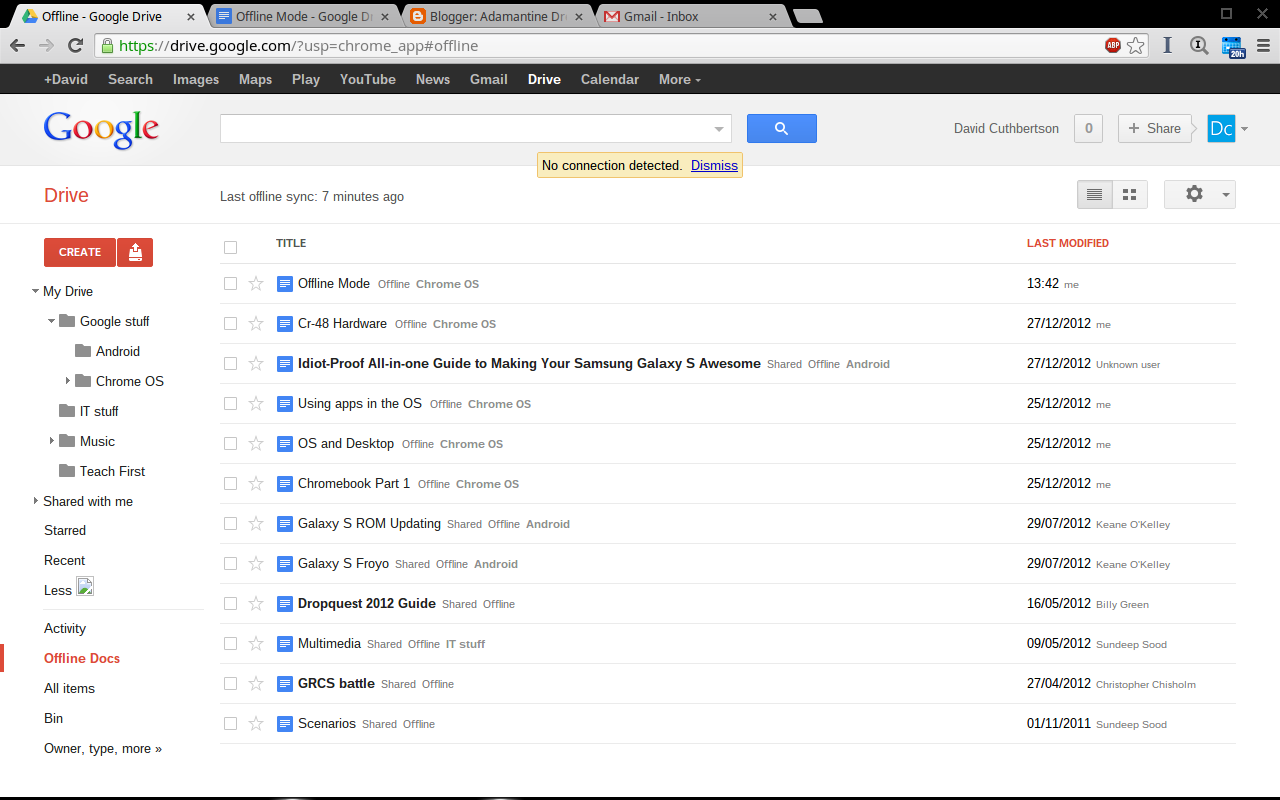
Although Google Drive has a hierarchy of files and folders when online, just like any other computer while, offline, there is no hierarchy, simply a long list of different files, rather than in their correct folders as they would appear online.

While I can understand that this is a simpler system, it becomes a little unwieldy as you have more and more documents. It is especially strang as the hierarchy is shown on the left of the webpage, as you can see below. As a Dropbox user, I am used to having every single file saved for offline use. This is a trade-off I would prefer not to make, but with only a 16GB SSD compared to other machines’ huge HDDs, I can understand why this decision has been made.


My Drive Offline Docs, in a list by "last modified"

Few apps with a decent offline mode

This is a small problem that require a certain amount of understanding. Windows, OS X and Linux programs generally all work online or offline. except perhaps internet browsers. Yet since Chrome OS is based on the browser, the vast majority of apps expect to have an internet connection, unless they have specific settings. Of the apps I have installed on the computer, about half work offline, while the others don’t run at all. Although this is initially jarring, once you understand which apps have an offline mode, you will be able to get by.

My biggest annoyance is the gap in functionality between their online and offline modes. This can be seen most obviously in the Gmail offline app when it is compared to the Gmail app. The offline app is much more like a smartphone or tablet app, whereas the the standard Gmail app is far more fully-featured and is exactly what a user would expected from a desktop operating system. This is especially disappointing as it is one of Google’s tent-pole services, something a user would expect to use day to day.


Offline Gmail and its tablet-like appearance and reduced features


It seems like the Chrome OS developers could do a bit more work to improve the app’s offline usability, rather than just give an excuse that perpetuates the idea that “Chromebooks are only good online”.

The same can be said about the lack of an offline spell-check in Google Docs. I have been used to corrections or suggestions on whatever platform I am on, including iOS devices whether online or offline. Google does not provide the spell-check offline. 
Strangely enough, I have found the Blogger website actually has a better spell-check than Google Docs, very odd!I imagine this is to reduce bloat on the tiny SSD, but the option to save at least one language of data would be nice. It is not a deal-breaker for me, as I am usually just writing notes on the Chromebook anyway prior to a final read through on my iMac, or at least in my flat when I will have access to the internet, but it still something different to the norm, that I need to remember. It does also mean that I am now forced to reread what I have typed, and it has actually made me edit what I have written previously. Perhaps that increase in self-editing is a good thing?

Usage

Having said all of this, in my usage, the Chromebook still did everything I needed it to do, even if it did not do everything I perhaps would have wanted it to do, making it a very good travel companion.

It was ready to go in seconds, due to its quick boot time and would play the small amount of music I had saved for offline use, or I could listen to the music on my phone. It also played a couple of episodes of a TV series I had on an SD Card, absolutely fine. I was easily able to transcribe handwritten notes in Google Docs and didn’t really need anything fancy. The Cr-48 is still a little too large for an aircraft’s tray table, but until I get my dream machine - an 11” MacBook Air, that would be the case with any other laptop I have.